You have written the cheque. You have signed it. You have handed it over to your vendor, employee, or supplier.
And then you get the call.
"The cheque bounced."
It is one of the most frustrating moments in business banking. Not only does it delay payment, but it also damages trust and can lead to penalties — especially in Qatar and across the GCC, where cheque bounce is treated very seriously.
The good news? Most cheque rejections are preventable. They happen because of simple errors that are easy to fix once you know what to look for.
In this guide, I will walk you through the 5 most common reasons why banks reject cheques in Qatar — and exactly how to prevent them.
What Does "Cheque Rejection" Mean?
When a bank refuses to process a cheque, it is called a 'cheque bounce' or 'dishonoured cheque'. The bank returns the cheque to the depositor along with a "Cheque Return Memo" that states the reason for rejection.
Cheque rejection can happen for both financial and non-financial reasons. Some are caused by the account holder. Others are caused by errors on the cheque itself.
Let us look at the 5 most common errors.
Error 1: Insufficient Funds
This is the most common reason for cheque bounce. The account does not have enough money to cover the cheque amount when it is presented for payment.
Why It Happens
- You wrote a cheque without checking the account balance
- You were expecting funds to arrive before the cheque was deposited, but they were delayed
- You forgot about a pending payment or automatic debit
How to Prevent It
| Prevention Tip | Why It Works |
|---|---|
| Check your balance before writing. | Simple, but often overlooked |
| Maintain a buffer. | Keep extra funds to cover unexpected delays. |
| Track pending payments | Know what is coming in and going out. |
| Set up alerts. | Many banks send low-balance notifications. |
Pro tip: If you are issuing multiple cheques, keep a running total of your commitments. This prevents accidental over-commitment.
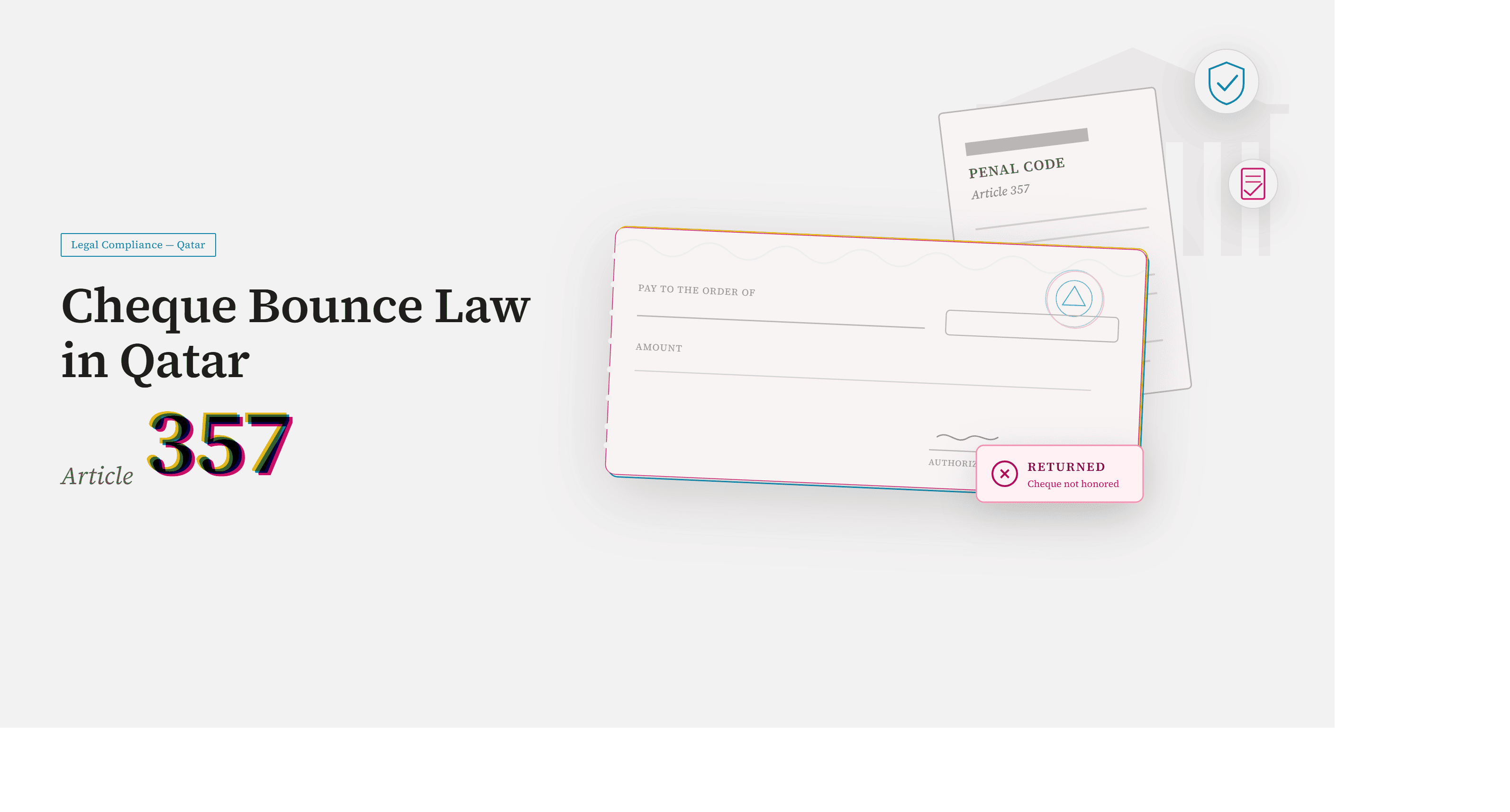
Qatar context: Under Qatar's Penal Code (Article 357), issuing a cheque without sufficient funds is a criminal offence. The penalties can include fines and even imprisonment.
Error 2: Signature Mismatch
Your signature on the cheque does not match the specimen signature your bank has on record.
Why It Happens
- You signed in a hurry, and the signature looks different
- You recently changed your signature but did not update the bank
- Someone else signed on your behalf without authorisation
- You used a different signatory pattern (initials vs. full signature)
How to Prevent It
| Prevention Tip | Why It Works |
|---|---|
| Use your consistent signature | Match the signature your bank has on file. |
| Slow down. | Rushed signatures are a common cause of mismatch. |
| Update bank records. | If you change your signature, inform your bank immediately. |
| Use authorised signatories. | Ensure anyone signing has the correct authority. |
Pro tip: If you are a company with multiple signatories, make sure everyone knows the correct signing pattern. Inconsistent signatures cause unnecessary rejections.
Qatar context: Qatari banks like QNB, CBQ, and Doha Bank use automated signature verification systems. Even minor variations can trigger a rejection during clearing.
Error 3: Incorrect or Incomplete Details
Any error in the cheque details can lead to rejection. This includes incorrect dates, mismatched amounts, or wrong payee names.
Common Detail Errors
| Error | Example |
|---|---|
| Amount mismatch | The amount in words says "Five Thousand", but the figures say "5,500". |
| Wrong date | Post-dated cheque presented early, or stale cheque presented late |
| Incorrect payee name | The name does not match the account holder's name. |
| Incomplete details | Missing payee name, date, or signature |
| Overwriting | Any correction or alteration on the cheque face |
How to Prevent It
| Prevention Tip | Why It Works |
|---|---|
| Double-check every field. | Read the cheque before signing. |
| Use cheque printing software. | Software auto-fills details, reducing errors. |
| Never overwrite | If you make a mistake, void the cheque and write a new one. |
| Verify payee name. | Use the exact name as it appears on the account. |
| Ensure amounts match | Words and figures must match exactly. |
Pro tip: Cheque printing software like Cheqaat eliminates detail errors automatically. The software converts amounts to words and ensures consistency across all fields.
Qatar context: Major Qatari banks like QNB, Doha Bank, and Commercial Bank of Qatar (CBQ) use automated high-speed cheque scanners. Even minor overwriting or alignment drift can lead to automated machine rejection during clearing.
Error 4: Stale or Post-Dated Cheque
Cheques have a validity period. In Qatar and most GCC countries, a cheque is typically valid for six months from the date written on it. Presenting a cheque outside this window causes rejection.
Stale Cheque vs Post-Dated Cheque
| Type | Date on Cheque | When Presented | Result |
|---|---|---|---|
| Stale Cheque | Past date (beyond validity) | After expiry | Rejected |
| Post-Dated Cheque | Future date | Before that date | Rejected |
Why It Happens
- You forgot to deposit the cheque within the validity period
- You presented a post-dated cheque before its date
- The cheque was issued but not deposited for months
How to Prevent It
| Prevention Tip | Why It Works |
|---|---|
| Deposit cheques promptly | Do not let them sit for months. |
| Track post-dated cheques. | Use a system to remind you of deposit dates. |
| Verify the date. | Check the date before presenting. |
| Issue fresh cheques. | If a cheque is stale, request a new one. |
Pro tip: If you manage post-dated cheques (PDCs) for rent, loans, or vendor payments in Qatar, use software that tracks dates and reminds you when to deposit.
Error 5: Account Issues (Frozen, Closed, or Dormant)
If the account is frozen, closed, or dormant, the cheque will be rejected.
Why It Happens
- The account has been closed, but old cheques are still in circulation
- The account is frozen due to legal or regulatory issues
- The account is dormant due to inactivity
- A stop payment instruction has been placed on the cheque
How to Prevent It
| Prevention Tip | Why It Works |
|---|---|
| Know your account status. | Check before issuing cheques |
| Keep accounts active. | Regular transactions prevent dormancy. |
| Destroy old cheque books. | If you close an account, destroy unused cheques. |
| Communicate with your bank. | Ensure no holds or freezes are in place. |
Pro tip: When closing an account, always destroy the remaining cheque leaves. This prevents accidental use of cheques from a closed account.
The Real Cost of Cheque Rejection in Qatar
Cheque bounce is not just an inconvenience. It has real consequences — especially in Qatar.
| Consequence | Impact |
|---|---|
| Bank penalties | Return fees charged by both banks |
| Legal action | In Qatar and across the GCC, cheque bounce is treated very strictly under criminal law (such as Article 357 of Qatar's Penal Code), leading to heavy fines or legal consequences. |
| Damaged relationships | Vendors and suppliers lose trust. |
| Credit impact | Repeated bounces can affect your creditworthiness. |
| Administrative time | Time wasted resolving the issue |
Important: In Qatar, issuing a cheque without sufficient funds is a criminal offence under Article 357 of the Penal Code. Penalties can include fines and imprisonment.
How Cheqaat Prevents Cheque Rejection
Cheqaat is a professional cheque printing software designed to eliminate the most common cheque errors.
| Error | How Cheqaat Prevents It |
|---|---|
| Incorrect details | Auto-converts amount to words, ensures consistency |
| Amount mismatch | Numbers and words are generated from the same source. |
| Payee name errors | Save payee details and reuse them accurately. |
| Overwriting | Print perfectly aligned cheques with no manual corrections. |
| Formatting errors | Pre-configured templates for major Qatari banks, including QNB, Doha Bank, CBQ, and QIB |
| PDC tracking | Manage post-dated cheques with date tracking. |
| Record keeping | Every cheque is logged automatically |
With Cheqaat, you print bank-ready cheques in under 60 seconds. No manual errors. No rejections.
Frequently Asked Questions
Why do banks reject cheques in Qatar?
Banks in Qatar reject cheques for several reasons, including insufficient funds, signature mismatch, incorrect details, stale or post-dated cheques, and account issues like frozen or closed accounts.
What is the most common reason for cheque bounce in Qatar?
Insufficient funds is the most common reason. The account does not have enough money to cover the cheque amount when presented.
Can a cheque bounce even if I have enough funds?
Yes. A cheque can bounce due to signature mismatch, incorrect details, overwriting, or technical reasons even if funds are available.
How long is a cheque valid in Qatar?
In Qatar and most GCC countries, a cheque is typically valid for six months from the date written on it. After this period, it becomes a stale cheque and will be rejected.
What is a post-dated cheque?
A post-dated cheque has a future date written on it. It cannot be processed until that date. Presenting it early will result in rejection.
What is the penalty for cheque bounce in Qatar?
In Qatar, issuing a cheque without sufficient funds is a criminal offence under Article 357 of the Penal Code. Penalties can include fines and imprisonment.
How can I prevent cheque bounce?
To prevent cheque bounce:
- Ensure sufficient funds
- Match your signature
- Double-check all details
- Deposit within validity period
- Use cheque printing software like Cheqaat
How do major banks like QNB or CBQ handle cheque clearing?
Qatari banks use automated high-speed cheque scanners as part of the Qatar Automated Transfer and Clearing System (QATCH). This means alignment, text clarity, and zero overwriting are critical to avoid machine rejection during clearing.
Can I reprint a bounced cheque?
Yes. If a cheque is bounced due to an error, you can issue a new cheque with corrected details. However, you must resolve the underlying issue (e.g., insufficient funds) first.
Final Thoughts
Cheque rejection is frustrating, but it is almost always preventable. The 5 most common errors — insufficient funds, signature mismatch, incorrect details, date issues, and account problems — can all be avoided with care and the right tools.
Quick prevention checklist:
- ✅ Check account balance before issuing
- ✅ Use consistent signature
- ✅ Double-check all details (payee, amount, date)
- ✅ Deposit within validity period
- ✅ Never overwrite — void and reissue
- ✅ Keep accounts active
- ✅ Use cheque printing software to eliminate errors
Whether you are a business owner, accountant, or finance professional in Qatar, following these steps will keep your cheques flowing smoothly.
Stop worrying about cheque rejections. Start printing cheques with Cheqaat.
Download Cheqaat for free today and print your first cheque in under 60 seconds. Need more features? View our pricing plans.
Check out our step-by-step guide to printing cheques or post-dated cheque management guide.
Built by TROJAN IT SOLUTION PVT LTD