Writing a cheque looks simple — until a small mistake gets it rejected at the bank. A mismatched amount, an unclear word, or a missing detail can send the whole thing back, costing you time and sometimes a wasted cheque leaf.
This guide shows you exactly how to write a cheque correctly, step by step, with special focus on the part most people get wrong: writing the amount in words. You'll find clear examples you can copy, the most common mistakes to avoid, and a faster way to handle cheques if you write them often.
Quick Answer: How do you write a cheque correctly?
To write a cheque correctly, fill in five things clearly: the date, the payee (who you're paying), the amount in figures, the amount in words (ending with "Only"), and your signature. The amount in words and figures must match exactly. Write clearly, avoid corrections, and don't leave blank spaces that could be altered.
The parts of a cheque
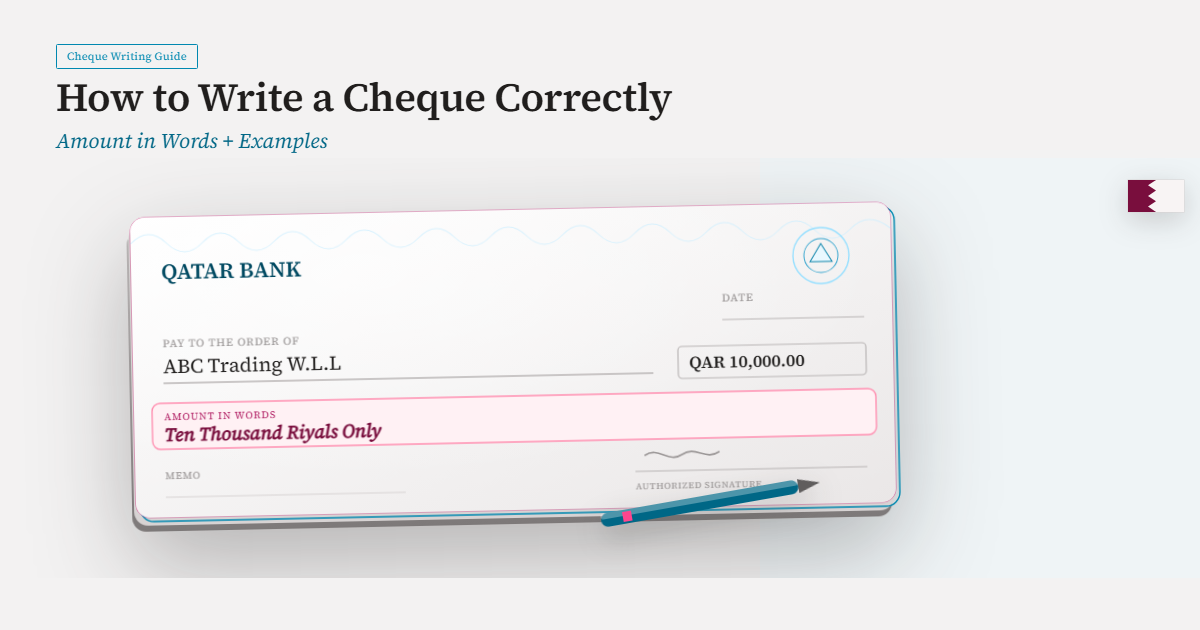
Before you write, know the fields you'll fill in:
- Date — the day you're issuing the cheque (top-right)
- Payee — "Pay to the order of" — the person or company receiving the money
- Amount in figures — the numeric amount, usually in a small box
- Amount in words — the amount written out in full
- Signature — your authorised signature (bottom-right)
The MICR line at the very bottom (the coded numbers) is pre-printed by your bank — you never write on it.
How to write a cheque — step by step
Step 1 — Write the date. Enter the current date (or a future date for a post-dated cheque). Use a clear, consistent format, e.g., 09/11/2026.
Step 2 — Write the payee's name. After "Pay to the order of", write the full, correct name of the person or company. Write it clearly — spelling matters, especially for business names.
Step 3 — Write the amount in figures. In the box, write the numeric amount, e.g., 10,000.00. Start writing close to the currency symbol so no digits can be added in front.
Step 4 — Write the amount in words. Write the same amount in full words, and end with "Only" so nothing can be added after it. (Full examples below.)
Step 5 — Sign the cheque Sign exactly as per your bank records. A mismatched signature is a common rejection reason.
Step 6 — Check before handing it over: confirm the figures and words match, the payee is correct, and there are no corrections or blank gaps.
H2: How to write the amount in words on a cheque (with examples)
This is where most mistakes happen. The rule: write the full amount in words, then "Only" at the end. Here are examples you can follow (shown in Qatari Riyals, but the method is the same anywhere):
| Amount (figures) | Amount in words |
|---|---|
| QAR 500 | Five Hundred Riyals Only |
| QAR 1,500 | One Thousand Five Hundred Riyals Only |
| QAR 7,250 | Seven Thousand Two Hundred Fifty Riyals Only |
| QAR 10,000 | Ten Thousand Riyals Only |
| QAR 25,750 | Twenty-Five Thousand Seven Hundred Fifty Riyals Only |
| QAR 100,000 | One Hundred Thousand Riyals Only |
| QAR 1,250.50 | One Thousand Two Hundred Fifty Riyals and Fifty Dirhams Only |
Key rules for the amount in words:
- Always finish with "Only" — it prevents anyone adding to the amount.
- The words must match the figures exactly.
- For amounts with fractions, write the main currency and the subunit (in Qatar, Riyals and Dirhams).
- Keep handwriting clear and on the line — no squeezing or overwriting.
H2: Common cheque-writing mistakes (and how to avoid them)
| Mistake | Why it's a problem | Fix |
|---|---|---|
| Figures and words don't match. | Bank rejects the cheque | Double-check both before signing. |
| Forgetting "Only" at the end | Amount can be altered. | Always end with "Only". |
| Leaving blank space before/after the amount | Opens the door to fraud | Start close to the symbol; draw a line after the words. |
| Unclear handwriting | Misread amounts, rejection | Write slowly and clearly — or print instead. |
| Overwriting or corrections | Banks often reject corrected cheques | Void it and write a fresh one. |
| Wrong or misspelled payee name | Can't be deposited | Confirm the exact legal name. |
| Signature mismatch | Rejected | Sign as per bank records. |
H2: A faster, error-free way — print your cheques
If you only write the occasional cheque, by hand is fine. But if your business issues cheques regularly — payroll, rent, vendors — handwriting them is slow, and the mistakes above add up.
Cheque printing software removes the two biggest risks automatically:
- It converts the amount in figures to words for you, so the two always match — no manual errors.
- It prints clearly and in the right positions, so there's no unclear handwriting or misalignment.
Cheqaat is cheque printing software built for businesses in Qatar: enter the details once, and it prints a clean, bank-ready cheque — amount in words included — in seconds. It also tracks post-dated cheques so none are missed.
Download Cheqaat free · See pricing
(Software prints the cheque accurately — but always make sure your account has sufficient funds before issuing one.)
H2: Frequently Asked Questions
How do you write the amount in words on a cheque? Write the full amount in words and end with ""Only"—for example, QAR 10,000 is written "Ten Thousand Riyals Only". The words must match the figures exactly.
Why do you write "Only" at the end of a cheque amount? Only "closes off the amount so no one can add extra words or digits after it." It's a simple fraud-prevention step.
What happens if the amount in words and figures doesn't match? The bank will usually reject the cheque. Many banks treat the amount in words as the legal amount, but a mismatch is a common reason cheques are returned.
Can I correct a mistake on a cheque? It's safer not to. Banks often reject cheques with corrections or overwriting. Void the cheque and write a fresh one.
Is it better to print or handwrite cheques? For occasional personal use, handwriting is fine. For businesses issuing cheques regularly, printing is faster, clearer, and prevents the common errors that cause rejections.
Conclusion
Writing a cheque correctly comes down to clarity and accuracy: fill in every field clearly, make sure the amount in words and figures match, always end the words with "Only," and avoid corrections or blank gaps.
If you write cheques often, consider printing them instead — it eliminates the amount-in-words and handwriting mistakes that cause most rejections, and it's far faster for payroll and vendor runs.
Download Cheqaat free and print accurate, bank-ready cheques in seconds.